
OSAKA
Neon lights, Glico Running Man, canals, bars, dodgy night-clubs, restaurants (and street-food), ENORMOUS market…. it's a thrill to just go and explore and try as much food as possible!!
What: sightseeing
Where: Osaka
No. of Nights: 4 (Days 7, 8, 9 & 10 of larger trip)
General observations about Japan so far
In the interim, I just want to lay out some general observations about Japan so far. A few small things can be a tiny bit annoying, but I must repeat, these are such minor things, and the fact that these are the main annoyances I have found really says everything. If issues this trivial counted as the major negatives in certain other countries, then we would have had to be transported to some infinitely nicer parallel universe or something. Because, quite honestly, Japan is incredible, and the Japanese people are abundantly delightful.
Plastic packaging galore!
On the surface, Japan appears to be a moderately environmentally friendly place. That said, they do seem to use so much plastic, and it is a bit ridiculous. Every single time I buy something, whatever it is, it is almost always wrapped in a thin film of plastic and then placed into a plastic bag, and this is done without question. I suppose it is a bit behind the times. For instance, compared to many parts of the world, Europe for example, where they charge for any type of plastic bag and the default is simply no bag at all unless you ask, it is less advanced. Not that charging for a plastic bag is especially advanced in itself. It is a bit of a pity. I can only imagine the copious amount of plastic waste coming from Japan. One source even claims that Japan generates more plastic packaging waste per person than any other country except the United States.
That said, most of the rest of the world is very far from perfect in this respect, very far indeed. We use far too much single use plastic, wherever we are, a frankly ludicrous amount. In England, for example, so much of the food packaging is plastic packaging, a great deal of which is single use. And the problem with plastic is really only scratching the surface of what is wrong with the way the world is being treated today, and not just by Japanese companies by any means at all. The world over is littered with supranational companies that ultimately care about one thing alone: monetary profit, and this is at the expense of everyone and everything else. It truly is disgraceful. I wish the government not only had the power but also the will to stop them, but all too often they seem to back down, either because they are being lobbied or quietly bought off.


Communication hurdles…
Some people, as incredibly friendly and helpful as they
almost always are, can have the exasperating talent of not thinking on their feet in certain situations, and I am probably guilty of this myself. I know I am generalising and perhaps flirting with offence, but I do not mean to upset anyone. If you are reading this, please take it with a pinch of salt and bear with me for a moment, because this sort of thing can happen to anyone, from anywhere.
So let me set the scene. Let us say there are several, say three or more, staff at the check out counter, or at the restaurant, or wherever it may be, and let us also suppose that one of them speaks better English than the others. I go about whatever it is I am doing — ordering food, asking for a sim card, whatever — and approach a female member of staff. Female or male makes no difference of course, but for writing purposes it is easier to refer to one. I politely ask whether she speaks English before continuing. Naturally, I do not presume anyone does, and it would be quite ungracious to bulldoze into conversation without first checking.
Right, so the scene is set. I have noticed that there are usually one of several reactions. She may shake her head, perhaps quite vigorously, or giggle shyly, or give some other body language indicating she does not speak English. She may make a dramatic crossing gesture with her arms, quite clearly signalling no — as happened when I was ‘rejected’ from the restaurant in Hiroshima on my first night. She may stare blankly, or almost ignore me. Alternatively, she may speak a very small amount and try her utmost to communicate, which, while extremely kind, gets us nowhere fast, because meaningful two way communication is still impossible.
In most of these scenarios, aside from when she has ignored me or walked off, the logical next step would be to ask a colleague to step in. Unfortunately, and this is what I cannot fully fathom, she often does not. Instead, she will politely continue to stare at me, waiting for me to figure things out. I have learnt that this is not awkwardness; it is politeness. Ending the interaction for her could be perceived as rude, so she honours the interaction by doing nothing while I flounder, which can feel mildly exasperating.
So I have learnt to be proactive from the outset. In a polite and friendly manner, I will simply ask her to summon a colleague, sometimes using hand gestures or, if necessary, a translation app, as I did on The Kumano Kodo. If that fails, I take the initiative myself and approach a co worker, and if he cannot help, then on to the next, and so forth. It can be a little frustrating, but at least there is a way. Imagine if no one spoke your language at all. I meet people all the time who barely speak any English and certainly no Japanese. Now that is really tough — and mildly terrifying if you are in a hurry.

Food Galore (but what is it?!)
By just looking at a restaurant from the outside — its outlook, name, and menu if it is on display — it is not easy to know, unless you have learnt this over time, what type of restaurant it actually is. Could it be Ramen, Okonomiyaki, Soba, Yakitori, Shabu-shabu, Izakaya, Tonkatsu, Tempura, Kare Raisu, Teishoku, Sushi (the list goes on…)? What is it? Because, to me at least, almost no restaurant will unambiguously state in English what type of food it serves. Luckily, some are easier to spot than others.
For instance, Sushi is usually relatively
obvious, especially once you peer inside. Even if there is no sushi conveyor belt, you will soon be able to tell what others are eating. I say ‘usually’ because there are plenty of high-end sushi places with no indication whatsoever of what they serve. Moreover, you may not even be able to gain access to find out: there will often be private rooms, long elaborate entrances, and no staff around to ask.


The likes of Japanese curry (Kare Raisu), Ramen, and Tonkatsu (for example, pork Katsu) are usually obvious thanks to the pictured menus outside. A bonus for tourists, certainly, though I doubt they were intended to make life easier for us — just a happy accident.
Then there are the displays that at first glance look like vending machines. The first time I saw one, that is exactly what I thought they were. It took a bit of watching a local to realise that this is actually where you select, pay for, and collect your food ticket before even stepping inside. Sometimes the machine is indoors, sometimes outdoors, but either way, it can be bewildering at first — slightly terrifying if you are hungry.

In Japan, many restaurants have these 'menus': select and pay before entering!

Food tickets obtained! Ramen restaurant in Osaka
If the type of food is not obvious from the outside, you will have to venture inside and try to work it out — time and energy permitting, of course. Needing to go inside usually means there are no pictures, and this in turn means you will have to either observe what others are eating, speak to the staff (see earlier notes on this delicate art), or try your luck asking for an English menu. At this point, I would put the chances of correctly identifying the type of restaurant at roughly fifty per cent, and much less if there are no diners to copy. In that case, you would probably be better off going elsewhere anyway.


Also worth noting: if, like me, you have an aversion to crustaceans or offal, or if you have allergies or religious requirements, you will almost certainly have no idea whether these ingredients are lurking in the food just from the picture. And even an English description is no guarantee. I have seen ‘vegetarian pasta with tomato and basil sauce’ triumphantly arrive containing seafood and minced meat. A ‘chicken skewer’ may in fact be chicken tail, heart, or cartilage. The surprises are endless. Most menus are not in English, and when they are, accuracy is something of a gamble.
But I must say, all of the above (minor) negatives are utterly dwarfed by the many positives — some of which I have sprinkled all over this piece. And anyway, it is all part of
the experience. I genuinely enjoy exploring, and have no qualms about making a fool of myself in the process. That said, when I am hungry, the thrill of the hunt does lose some of its shine.
Osaka, general remarks
Osaka is a city that strikes you immediately, though not always in the ways you might expect. Step out of a centrally located hotel, and you find yourself in a seemingly endless expanse of streets lined with food establishments, bars, and tiny shops. Unlike the winding lanes of Kyoto to come later, these streets are straight, long, and uniform, stretching away in monotonous succession. Restaurant upon shop upon bar upon club, repeated endlessly, all under a lattice of thick black power lines overhead. The scale is staggering, yet somehow it feels calculated, almost oppressive in its regularity.
By night, the city is awash with neon lights, buzzing signs, the chatter of people, clatter of dishes, and the enticing aromas of sizzling food — grilled meat, fried noodles, rich sauces. And yet, despite all this energy,

there is a strange uniformity to it all. The lights are bright, the colours vivid, but the effect is almost synthetic, artificial, as if the entire scene has been orchestrated. It is dazzling, yes, but also somewhat dull, gloomy, and oddly melancholy beneath the spectacle.
For me, Osaka is not quite my cup of tea. It is not only because of the rigidity, the relentless straightness of the streets, or the sense that everything is fabricated for effect rather than discovered organically; there is something else, something that stems from this, that I cannot quite put my finger on right now. Whatever it is, it feels the opposite of what I anticipate in Kyoto: calmer, quieter, more contemplative, and somehow more alive in its subtler textures. Still, wandering Osaka’s streets, lost in the lights, sounds, and smells, is an experience that cannot be forgotten — even if it leaves you with a strange mixture of awe and unease.

Dottonburi and Ebisu-Bashi Suji shopping street
Dottonburi at night is something else. Neon signs blaze in every imaginable colour, reflected in the canal and bouncing off shop windows. The hum of people, bursts of laughter, clatter of dishes, and the aromas of grilled meat, takoyaki, and okonomiyaki swirl together, pulling you along the street. And there it is — the Glico Running Man, lit up and larger than life, watching over the crowd.
A short walk away, Ebisu-Bashi Suji stretches for over a kilometre. This historic district in Osaka’s Minami area dates back to the Edo period, yet it buzzes with life. Old shops rub shoulders with trendy fashion outlets, and the street food tucked into its long, long, long(!) corridors is irresistible.
Unlike the straight, uniform streets elsewhere in Osaka, these streets feel alive. There is warmth in the chaos, a rhythm that seems genuine rather than orchestrated. Walking here, you sense the weight of history, the pulse of the present, and the simple joy of people eating, chatting, and exploring. It is Osaka at its most authentic — bright, bustling, and utterly unforgettable.
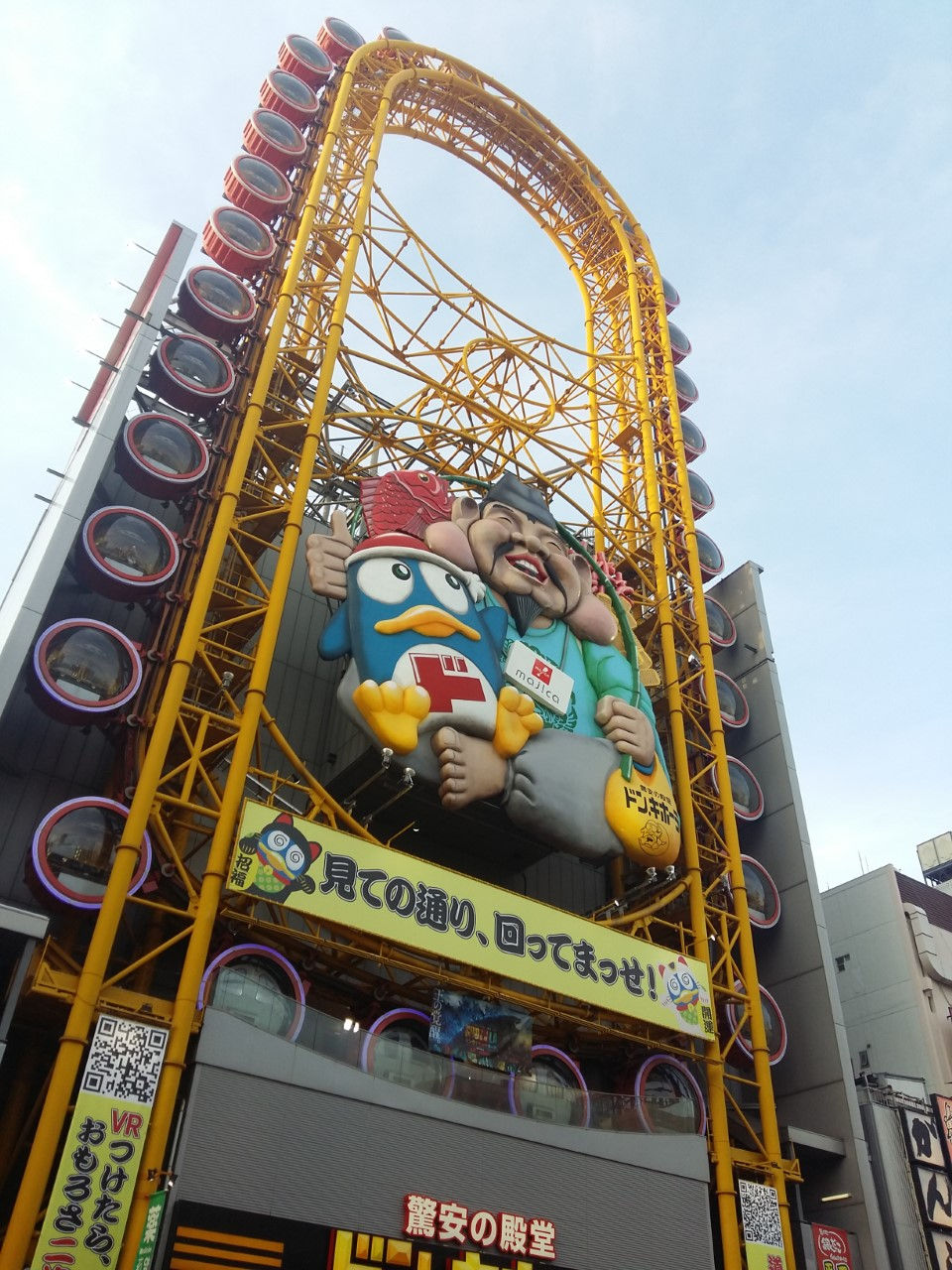


Morning-stroll & coffee
One morning after breakfast, I wander outside and drift around for hours, letting the city lead me. Eventually, I stumble across a superb coffee house that roasts its own beans. I order a freshly roasted, freshly ground cold brew, and in the scorching heat, it is perfectly refreshing. I settle in a small square in the middle of a pedestrianised area, and the scene is something else entirely.
I settle in a small square in the middle of a pedestrianised area, and the scene is something else entirely. Tattoo artists set up their workstations on the pavement, bizarre performers juggle and dance, and people in all sorts of wild costumes wander past — glittering outfits, oversized hats, neon wigs, leather, feathers, you name it. Musicians tune their instruments in the corners, and street-food stalls send waves of sizzling, aromatic temptation into the air.
Sitting there with my cold brew, I watch it all unfold: the strange, colourful parade of the city, people laughing, performing, and drifting by. It is chaotic, vibrant, sometimes absurd, but utterly alive. I sip, relax, and feel as if I am observing a parallel world — one that exists just for a moment in this square, in this part of Osaka, while the world continues around me.


One evening, I meet a friendly local I’d been put in contact with. He takes me to a completely different part of the city, quieter and less hectic than anywhere I’ve seen so far. We settle on a fantastic spot for Shabu-shabu. It is a bit costly but absolutely worth it. Afterwards, we wander back to the station, and I am dropped back where we started, full and very satisfied.
I’m staying at a Candeo Hotel, which has a rooftop spa, much like the one in
Hiroshima. Not quite as impressive, but still very pleasant. It is a perfect way to unwind after a long day of exploring. Another evening, I head to a quirky local restaurant nearby. The Teishoku is delicious, and the waitress seems determined to practise her English on me. With no one else to chat to, I am happy to indulge her, and she proves to be very friendly and entertaining company.


Himeji-jo
I also took a day trip to Himeji-jo – reputedly one of Japan’s most stunning castles, a UNESCO World Heritage site, a national treasure, and one of the few original castles still standing (many others, like Hiroshima Castle, are reconstructions). Indeed, it is very impressive and truly looks stunning.
Apart from that, I’m not too sad to be leaving Osaka. Unless it’s for business or food, I struggle to find a compelling reason to return—at least in a hurry. People here are generally very friendly, of course, though they do seem a bit more brash and loud than in other parts of Japan I’ve visited. That’s not a bad thing, though! I’m glad I got to experience this unusual place


